If you’re searching for an honest lodgify review, you’re probably facing a question a lot of American vacation rental owners eventually run into: keep depending entirely on Airbnb and VRBO, or start building a direct-booking business you actually own.
This review is based on evaluating Lodgify’s public pricing structure, feature set, and documented capabilities as of 2026, cross-referenced against how independent hosts and small property managers across the U.S. are actually using direct-booking platforms in practice — not just how the marketing pages describe them.
The short-term rental industry has shifted noticeably over the past few years. Professional hosts are increasingly looking past marketplaces and investing in their own brands, websites, email lists, and repeat-guest systems. Lodgify has positioned itself at the center of that movement, promising an all-in-one platform where hosts build branded websites, sync calendars, process payments, and take direct reservations without leaning entirely on OTAs.
Reality, as usual, is a bit more complicated than the pitch. For some operators, Lodgify becomes a genuinely valuable long-term asset. For others, it adds cost and responsibility without much return. After looking at how hosts in Florida, Tennessee, Arizona, and North Carolina are actually running these platforms, one thing becomes clear fairly quickly: technology matters here, but the underlying business strategy behind it matters more.
This guide walks through the practical realities of Lodgify, its pricing structure, how it stacks up against Hostaway, and how to figure out whether a direct-booking ecosystem actually fits your goals.
Quick Answer
Lodgify is a vacation rental direct booking website builder that lets hosts create branded booking websites, sync calendars, accept payments, and manage reservations from multiple channels. It works especially well for hosts focused on repeat guests, brand ownership, and long-term growth — single-property owners with limited marketing ambitions may find simpler solutions serve them just as well.
What Is Lodgify?
Lodgify is a vacation rental software platform that helps property owners create direct-booking websites, synchronize calendars across OTAs, process guest payments, and manage reservations. It’s particularly useful for hosts seeking more independence from Airbnb and VRBO while building their own hospitality brand.
Why Direct Bookings Matter More Than Ever
Five years ago, most independent hosts relied almost entirely on Airbnb. That landscape looks different now. Professional operators increasingly want lower dependence on OTA algorithms, better control over guest relationships, access to their own customer email lists, stronger margins from repeat visitors, and real brand recognition of their own — which is a big part of why platforms like Lodgify have grown in popularity.
Direct bookings do come with responsibilities that marketplaces traditionally absorbed on the host’s behalf: website management, marketing campaigns, SEO, customer acquisition, payment processing, and brand development all fall on you instead. Owning your audience creates real opportunity, but it comes with accountability attached. Understanding that trade-off honestly is worth doing before investing in any software here.

Common Myths About Lodgify
As interest in direct bookings has grown, a few misconceptions keep circulating among hosts. Some have a kernel of truth in them. Others don’t hold up under scrutiny.
“Lodgify eliminates Airbnb fees completely.” Many hosts assume launching a direct-booking website removes OTA dependence right away. In practice, generating real website traffic requires SEO, email marketing, social media presence, repeat guests, and brand awareness — none of which appear overnight. For most operators, Airbnb stays an important acquisition channel even after a successful direct-booking site launches. The smarter operators treat marketplaces as a marketing tool rather than a competitor to eliminate.
“Every host needs a direct booking website.” This assumption creates pressure that isn’t always warranted. A host managing one lake cabin with occasional reservations may gain very little from an independent website. Direct booking strategies tend to pay off when multiple properties exist, repeat guests are common, some marketing system already exists, brand identity matters, or expansion is genuinely underway. Sometimes the simpler path really is the better business decision.
“Setup only takes a few hours.” Technically, a website can go live quickly. An effective hospitality website is a different story — writing compelling descriptions, configuring payments, creating policies, connecting calendars, testing the reservation flow, and optimizing for mobile all take real time. The software itself isn’t hard to use. Building a guest-ready business around it takes considerably more planning.
“Direct bookings automatically increase profits.” This is probably the most dangerous assumption of the four. Avoiding OTA commissions sounds great on paper, but direct channels bring their own costs — subscription fees, payment processing charges, marketing budgets, domain registration, design work, email software, and SEO investment. Profitability comes down to execution, not simply removing marketplace fees from the equation.
The Reality Behind Those Myths
Experienced operators rarely walk away from Airbnb overnight. They diversify instead.
OTAs still deliver real value — global visibility, consumer trust, reliable traffic, international reach, and payment systems that are already built and trusted. Most successful businesses combine direct channels with OTA exposure rather than picking one. The goal is reducing dependency, not eliminating opportunity altogether.
Brand ownership, meanwhile, offers something marketplaces simply can’t: control over customer relationships, your own email database, your own marketing campaigns, your own pricing strategy, loyalty programs, and retargeting opportunities. Those assets compound in value the longer you hold onto them.
It’s also worth being clear-eyed about what Lodgify actually solves. It handles reservations, calendar sync, payment collection, and website creation well. What it doesn’t automatically generate is search traffic, repeat customers, brand loyalty, or social proof — those still take real marketing work. Technology amplifies a system that’s already working. It rarely replaces the need for one.
And none of this happens fast. The strongest direct-booking businesses weren’t built in six months — they were built over years of repeat-visitor databases, seasonal email campaigns, referral programs, and organic search visibility slowly compounding. Patience tends to outperform shortcuts here.
| Myth | Reality |
|---|---|
| Lodgify replaces Airbnb completely | Most hosts maintain multiple channels |
| Direct websites guarantee higher profits | Marketing and operating expenses remain |
| Setup is instant | Effective implementation takes planning |
| Every host needs direct bookings | Benefits depend on goals and scale |
| Technology drives growth alone | Branding and guest relationships matter equally |
The distinction between software and business strategy is probably the single most important lesson in this whole space.
Lodgify Pricing Plans Explained
Understanding lodgify pricing plans means looking past the subscription number itself and asking what business problem you’re actually trying to solve.
Smaller operators typically get what they need from entry-level plans — website creation, calendar sync, direct reservations, payment processing, and basic integrations. That’s usually enough for a single-property owner or a side-income host, where the priority is simplicity over sophisticated automation.
Growing operators tend to need more — better customization, stronger reporting, additional integrations, and expanded management tools. At this stage, direct bookings start supporting real business objectives rather than functioning as an experiment on the side.
Larger portfolios typically demand team management features, advanced automation, multi-property coordination, and operational analytics. Scalability matters far more here than the headline price — the cheapest plan today can quietly turn into an expensive migration problem down the road.
It’s also worth budgeting for costs beyond the subscription itself: payment processing charges, domain registration, email marketing software, premium integrations, custom design work, and any advertising budget you commit to. Understanding the full cost picture leads to a much better investment decision than looking at the sticker price alone.
Lodgify Pricing 2026: What Should Hosts Expect?
Conversations around lodgify pricing 2026 increasingly focus on value rather than the raw subscription figure. A few industry trends are shaping that.
Hosts now expect more built in by default — automated messaging, revenue insights, mobile management, multi-channel sync, and guest communication tools all tend to affect where pricing lands. Direct bookings also require real marketing support (SEO, email, repeat-guest campaigns, brand development), and software providers are increasingly building those capabilities directly into their platforms rather than leaving hosts to source them separately. And scalability keeps mattering more — a platform that works beautifully for one cabin can genuinely struggle at ten properties, so it’s worth evaluating software against where you expect to be in a few years, not just where you are now.
What Successful Hosts Actually Do
After looking at independent operators across Florida, Tennessee, Arizona, and North Carolina, one pattern shows up consistently: the most profitable hosts don’t choose between OTAs and direct bookings. They combine both.
They treat Airbnb as a marketing channel rather than a rival — using its global exposure, guest trust, and consistent discovery to acquire first-time visitors, build credibility, and eventually introduce those guests to their own brand. The goal isn’t replacing Airbnb. It’s building independence alongside it.
They also invest deliberately in their own brand assets — their website, their customer email database, their social presence, and their guest communication systems. Those assets hold their value regardless of what Airbnb’s algorithm does next, which is exactly the kind of resilience that owning your own channel provides.
And they lean hard into repeat guests, because returning visitors are almost always cheaper to acquire, easier to communicate with, and more likely to book directly the second time around. That’s the whole logic behind investing in a direct-booking ecosystem in the first place — the second reservation from a guest is usually more profitable than the first.
Real-World Example: A Tennessee Cabin Owner
Consider a cabin owner near Gatlinburg who started with every single reservation coming through Airbnb. Over time, rising competition, higher operating costs, and heavier dependence on marketplace visibility started squeezing profit margins.
The owner eventually moved to a hybrid strategy: Airbnb handled first-time guests, built visibility, and established trust. VRBO picked up family travelers and longer stays. A direct website took over repeat visitors, offering seasonal promotions, flexible booking benefits, early-access windows, and more personalized communication than any OTA message thread allows.
Nothing about this meant abandoning marketplaces — it meant building multiple sources of demand at once, which meaningfully reduced how exposed the business was to any single platform’s changes.
Step-by-Step Implementation Guide
Building a direct-booking business benefits from real structure rather than winging it.
Step 1: Define your objectives. Are you after more repeat bookings? Reducing platform dependence? Planning to manage multiple properties eventually? Is branding actually important to your long-term goals? Clear answers here make every later decision easier.
Step 2: Secure a strong domain name. Short, memorable, easy to spell, and relevant to your location or brand — something like SmokyMountainRetreats.com or GulfCoastVacationHomes.com. Brand identity matters more here than most hosts expect going in.
Step 3: Build the essential website pages. At minimum: property listings, booking functionality, contact information, house rules, cancellation policies, local recommendations, and an FAQ section. Transparency builds trust, and trust is what actually improves conversions.
Step 4: Synchronize calendars reliably. This is the piece that prevents double bookings, pricing inconsistencies, and the kind of guest frustration that turns into a bad review fast.
Step 5: Establish payment systems properly — processing, security, refund policies, chargeback procedures, and clear guest communication around all of it.
Step 6: Build real marketing processes. A beautiful website with no visitors doesn’t accomplish much on its own — SEO, email campaigns, repeat-guest outreach, referral programs, and social visibility are what actually bring people to it.
Tools That Support Growth
A direct-booking platform rarely operates in isolation. Dynamic pricing tools help optimize seasonal rates, event-driven demand, and holiday premiums automatically. Property management systems centralize guest messaging, cleaning coordination, and team communication as things scale — this is where comparing Hostaway and Guesty becomes relevant once a direct-booking business grows past a single property. Email marketing platforms keep repeat guests engaged through seasonal campaigns and loyalty incentives long after checkout. And analytics tools help make sense of what’s actually converting versus what just looks good.
Lodgify vs Hostaway
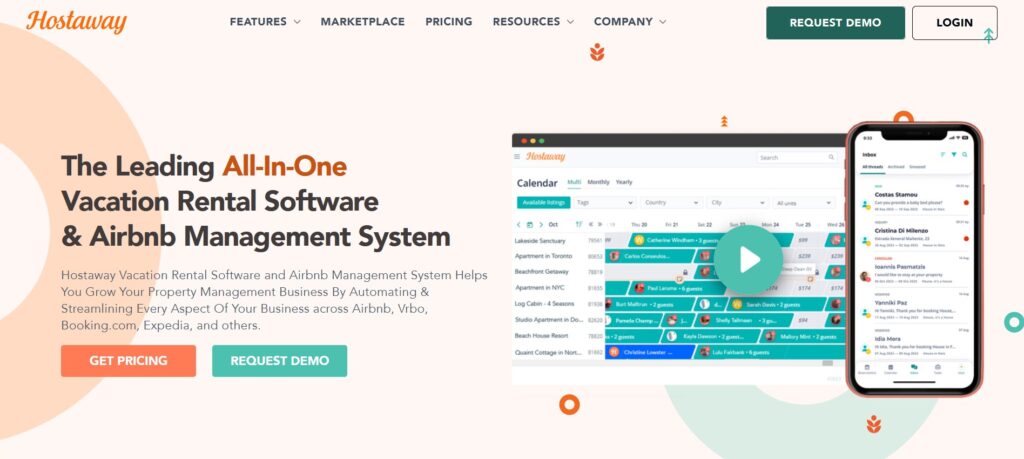
The lodgify vs hostaway comparison largely comes down to what you’re actually trying to build.
| Category | Lodgify | Hostaway |
|---|---|---|
| Direct booking website builder | Excellent | Limited |
| Ease of setup | Very user-friendly | More complex |
| Automation capabilities | Moderate | Advanced |
| Multi-property support | Good | Excellent |
| Best for independent hosts | Outstanding | Good |
| Best for large managers | Moderate | Excellent |
Lodgify tends to work well for small portfolios, brand-focused hosts, and hosts who want ownership and independence more than heavy automation. Hostaway tends to win out for property management companies, larger teams, and complex multi-property operations where operational sophistication matters more than website creation.
Neither one is universally better — the real question isn’t which software is superior, it’s which one actually supports the business model you’re running.
Is a Direct Booking Website Builder Actually Worth It?
Lodgify markets itself as a comprehensive vacation rental direct booking website builder, but it’s worth evaluating honestly against your own goals rather than the marketing copy.
It tends to make sense when repeat guests are common, brand ownership genuinely matters to you, multiple properties exist, marketing interests you, and long-term independence is a real priority — those circumstances tend to produce a strong return on the investment.
Simplicity wins in other cases — one seasonal cabin, limited occupancy goals, minimal interest in marketing, and mostly passive income objectives. In that situation, focusing on writing a stronger Airbnb listing description and general Airbnb optimization may deliver better returns than adding a whole new platform to manage.
Increasingly, experienced operators land somewhere in the middle — keeping Airbnb visibility and VRBO exposure while building direct-booking capability on the side. That balance creates both security and upside at the same time.
Lodgify Implementation Checklist
☑ Define business objectives
☑ Purchase a branded domain
☑ Build essential website pages
☑ Connect OTA calendars
☑ Configure payment systems
☑ Establish cancellation policies
☑ Create email collection systems
☑ Develop repeat-guest campaigns
☑ Monitor website analytics
☑ Review growth opportunities annually
Frequently Asked Questions
Is Lodgify worth it for one Airbnb property?
It depends on your goals. Hosts focused on repeat guests, branding, and long-term growth may benefit significantly. Others may find simpler approaches more practical.
What are Lodgify pricing plans like?
Lodgify pricing plans generally vary by property count, features, integrations, automation requirements, and team management needs. The best plan depends on your operational goals more than property count alone. Current pricing details are available directly on Lodgify’s official pricing page, since plans and tiers do change periodically.
How does Lodgify compare with Hostaway?
The comparison largely comes down to priorities: Lodgify emphasizes direct bookings, website ownership, and ease of use, while Hostaway focuses on automation, multi-property operations, and advanced management systems.
Can Lodgify completely replace Airbnb?
For most hosts, no. Airbnb remains one of the most effective customer acquisition channels available, and direct websites usually complement marketplace exposure rather than replace it outright.
Do direct-booking websites increase profits?
They can, but profitability depends on marketing effectiveness, guest retention, operating expenses, and brand development. Removing OTA commissions alone doesn’t guarantee higher margins.
Final Verdict
This lodgify review really comes down to one question: are you building a listing, or building a hospitality brand?
If your goals include repeat guests, brand ownership, lower marketplace dependency, long-term scalability, and more control over your customer relationships, a direct-booking platform deserves serious consideration. If you’re running a single property with modest marketing ambitions, putting that same energy into Airbnb optimization may get you further, faster.
Across the U.S. hosts and operators reviewed for this piece, almost none of them picked one path exclusively — the ones building something that lasts tend to combine marketplace visibility with direct guest relationships, professional systems, and a genuine long-term strategy behind the technology. The software is only ever as good as the plan sitting underneath it

Leave a Reply