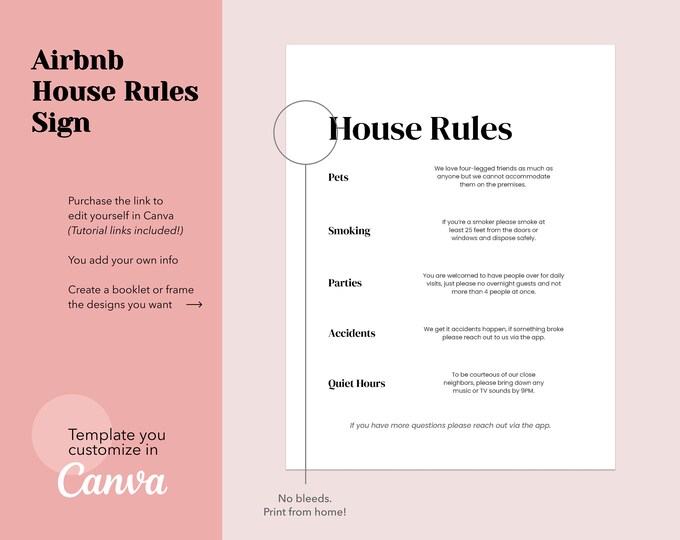
A vague set of Airbnb house rules causes more disputes than an overly strict one ever will. Guests who genuinely don’t know parking is limited, that quiet hours start at 10pm, or that the property sleeps six and not ten, don’t set out to break the rules — they just never had them clearly explained in the first place. Well-written house rules prevent that entire category of problem before it starts, and they work alongside a solid listing description to set accurate expectations from the very first click.
Quick Answer
Airbnb house rules are the specific guidelines a host sets for guest behavior during a stay — check-in and checkout times, occupancy limits, noise policies, pet and smoking rules, and any property-specific requirements. They’re added or edited through the listing’s House Rules section in Airbnb’s dashboard, and while they aren’t a separate legal contract in the traditional sense, guests agree to them as part of Airbnb’s Terms of Service when booking, giving hosts real standing to enforce violations through the platform. The strongest house rules are specific and property-relevant rather than a long generic list copied from another listing.
What Are Airbnb House Rules?
Airbnb house rules are the specific expectations a host sets for how guests should behave and use the property during their stay. They appear on the listing itself, are shown again to guests before they confirm a booking, and function as the reference point if a dispute arises later about parking, noise, guest count, or any other property-specific expectation.
Unlike a generic terms-of-service document, house rules work best when they’re tailored to the actual property rather than copied wholesale from another listing — a beachfront condo with a shared pool has genuinely different concerns than a standalone mountain cabin, and rules that reflect the real property read as more credible to guests than a boilerplate list.
Are Airbnb House Rules Legally Binding?
This is a common question, and the honest answer requires some nuance rather than a flat yes or no. House rules themselves aren’t a standalone legal contract the way a formal lease agreement is. However, when a guest books through Airbnb, they agree to the platform’s Terms of Service, which includes a commitment to follow the house rules attached to that specific listing — meaning a violation genuinely does give a host standing to report the issue through Airbnb’s resolution process, and in more serious cases, pursue a claim for damages.
This isn’t legal advice, and enforceability specifics can vary by jurisdiction and the nature of the violation — a minor noise complaint and significant property damage aren’t treated identically, and a host facing a serious dispute should consult an attorney rather than relying solely on the house rules text. What house rules reliably provide, even outside a formal legal framework, is a clear, documented reference point that strengthens a host’s position when working through Airbnb’s own resolution process.
How to Write House Rules for Airbnb That Actually Work
Be specific rather than generic. “Respect the property” says nothing actionable. “No shoes inside — slippers are provided by the door” tells a guest exactly what’s expected and why it matters.
Cover the property-specific details a generic list would miss. A hot tub needs its own usage hours and safety notes. A shared driveway needs a clear parking policy. A property with sensitive neighbors needs explicit noise guidance beyond a vague “be respectful” line.
Explain the reasoning briefly where it helps compliance. “Quiet hours after 10pm — we have close neighbors” gets followed more consistently than “Quiet hours after 10pm” alone, since guests generally comply more readily with rules they understand the purpose behind.
Keep the list genuinely scannable. A wall of text buried in the listing description gets skimmed or skipped entirely. Short, clear bullet points under logical categories (check-in, noise, guests, pets, smoking) get actually read before arrival.
Match tone to your property and target guest. A family vacation home benefits from a warmer, more welcoming tone even while covering firm rules. A business-traveler-focused city apartment can be more direct and efficient without feeling cold.
Airbnb House Rules Examples by Category
Check-in and checkout: “Check-in after 3pm, checkout by 11am. Early check-in or late checkout may be available — just ask before your stay.”
Occupancy: “This property sleeps a maximum of 6 guests. Additional unregistered guests are not permitted and may result in reservation cancellation.” Confirming guest count matches the booking is also one of the simpler checks covered in our guide to Airbnb guest screening.
Noise: “Quiet hours are 10pm-8am. We have close neighbors and appreciate your consideration, especially with outdoor spaces after dark.”
Parking: “One vehicle in the driveway, please. Street parking is available for additional vehicles — check posted signs for restrictions.”
Pets: “Pets are welcome with prior approval and a pet fee. Please keep pets off furniture and clean up after them in the yard.”
Smoking: “This is a smoke-free property, including vaping. Smoking is permitted in the designated outdoor area only.”
Parties and events: “No parties or events. This policy is strictly enforced and violations may result in immediate cancellation without refund.” Enforcing this rule consistently also matters for insurance and liability protection, since unauthorized events are a common source of property damage and guest injury claims.
General property care: “Please treat the home as you would your own. Report any damage or issues promptly so we can address them quickly.”
Airbnb House Rules Template
A practical structure for organizing rules on a listing:
Check-in / Checkout — arrival and departure windows, self-check-in instructions if applicable, early/late request process.
Occupancy — maximum guest count, policy on unregistered visitors.
Noise & Neighbors — quiet hours, any specific neighbor considerations.
Parking — number of spaces, location, any restrictions.
Pets — allowed or not, any fees, behavior expectations.
Smoking — policy and designated areas if applicable.
Parties/Events — explicit policy, since this is one of the most commonly violated rules across the platform.
Property-Specific Notes — anything unique to your property (pool hours, hot tub rules, shared spaces, appliance instructions).
Using this structure as a starting framework, then filling in details specific to your actual property, produces house rules that feel genuine rather than copied — which tends to earn more actual compliance from guests than a generic template used unchanged.
How to Add House Rules to Airbnb
Adding house rules is done directly through your listing settings. Navigate to your listing, find the House Rules section (typically under the listing details or policies area), and enter your rules in the provided fields — Airbnb offers some standard toggles (pets allowed, smoking allowed, events allowed) alongside a free-text area for custom, property-specific rules.
How to Change or Edit House Rules on Airbnb
Updating existing house rules follows the same path — return to the House Rules section within your listing settings, and edit the existing text or toggle settings as needed. Changes apply going forward and are shown to guests booking after the update; a guest who already booked under the previous rules should generally be informed of significant changes directly rather than assuming they’ve seen the update automatically. Airbnb’s help center covers the current exact navigation, since settings menus shift periodically with app updates.
Common House Rules Mistakes
Making the list too long and generic. Guests skim past an exhaustive list of obvious rules (“don’t damage the property,” “be respectful”) without absorbing the specific, property-relevant details that actually matter.
Burying important rules in dense paragraphs instead of clear, scannable bullet points organized by category — the format that actually gets read before arrival.
Never updating rules after a recurring issue emerges. If multiple guests violate the same rule, that’s usually a sign the rule needs to be clearer or more prominent, not just repeated identically hoping the next guest reads more carefully.
Setting rules so restrictive they discourage bookings, without a corresponding safety or property-protection reason — an overly long list of prohibitions can make a listing feel unwelcoming before a guest even books.
Failing to explain the reasoning behind rules that benefit from context. A bare list of prohibitions reads as more adversarial than the same rules paired with a brief, friendly explanation of why they exist.
Frequently Asked Questions
Are Airbnb house rules legally binding?
Not as a standalone contract, but guests agree to follow house rules as part of Airbnb’s Terms of Service when booking, which gives hosts real standing to report violations through Airbnb’s resolution process. Serious disputes involving damage or significant violations may warrant legal consultation beyond relying on the house rules alone.
How do I add house rules to my Airbnb listing?
Go to your listing settings and find the House Rules section, where you can toggle standard policies (pets, smoking, events) and add custom, property-specific rules in the free-text field.
Can I change my house rules after guests have already booked?
Yes, house rules can be edited at any time through your listing settings. Changes apply to future bookings; for guests who already booked under previous rules, directly communicating significant changes is recommended rather than assuming they’ll notice automatically.
What should Airbnb house rules include?
At minimum: check-in/checkout times, maximum occupancy, noise expectations, parking policy, and clear stances on pets, smoking, and parties/events. Property-specific notes (pool hours, shared spaces) round out a complete list.
Should I use a generic house rules template or write my own?
A template provides a useful starting structure, but the most effective house rules are customized to your actual property’s specific concerns and features, rather than copied unchanged from another listing.
Conclusion
Airbnb house rules work best as a clear, specific, genuinely readable reference — not an exhaustive list of generic prohibitions guests skim past without absorbing. Organizing rules by category, explaining the reasoning where it helps compliance, and tailoring the list to your actual property rather than a copied template produces house rules that guests actually follow, and that give you real standing if a dispute does arise despite reasonable, clearly communicated expectations — the same attention to detail that supports the strong reviews behind Superhost status.


Leave a Reply